
Leonor Cerdá and Euro-BioImaging’s Role in Analyzing Complex Data
The medical imaging revolution depends not only on increasingly sophisticated acquisition technologies, but also on the ability to efficiently process and interpret large volumes of data. In this context, artificial intelligence (AI) and high-performance computing have become key elements in transforming complex data into knowledge relevant to research and clinical practice.
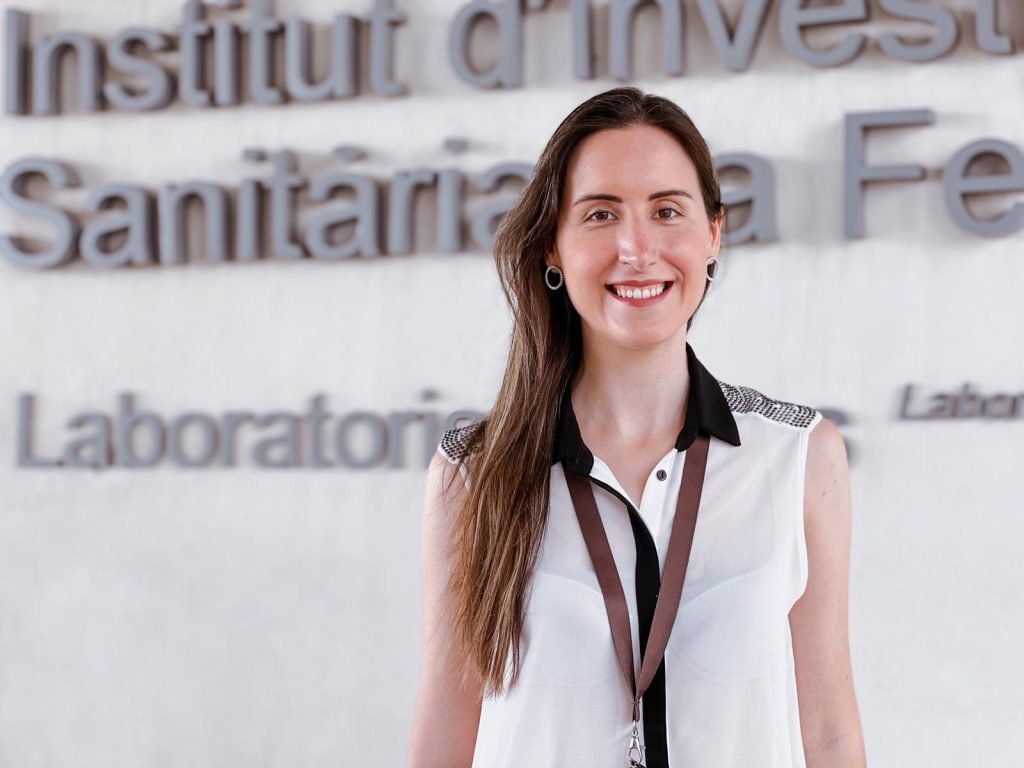
A clear example of this convergence between imaging and computing is the work of Leonor Cerdá, co-Principal Investigator of the Biomedical Imaging Research Group (GIBI230), a leading facility within the Euro-BioImaging nodes in Spain.
From Particle Physics to Medical Imaging
Leonor Cerdá holds a Ph.D. in Physics and began her career in a highly data-intensive environment: the ATLAS experiment at CERN (Switzerland), where she worked on analyzing large volumes of data in particle physics.
After this international stint, she returned to Spain to lead the Computing and Artificial Intelligence division at GIBI230, applying her expertise in big data analysis and complex architectures to the field of medical imaging.
“Medical imaging generates an extraordinary amount of multimodal information. The most exciting part is developing advanced computational approaches and high-performance architectures that allow us to extract meaningful insights from this data and translate them into biomedical advances.”
— Leonor Cerdá
Turning Data into Knowledge: The Role of AI
As head of the AI department, Leonor coordinates projects that integrate medical imaging, artificial intelligence, and advanced computing infrastructures, serving as a bridge between clinical needs and technological possibilities.
Her work enables researchers and users to:
Design AI-based image analysis strategies tailored to their scientific objectives.
Estimate and optimize the computational resources required for each project.
Orchestrate High Performance Computing (HPC) infrastructures for the efficient processing of large datasets.
Extract specific biomarkers from complex images.
Perform advanced analysis and validation of results (post-hoc analysis).
This comprehensive support is particularly valuable for groups that lack prior experience in AI or their own computational resources.
Reducing Barriers to Drive Innovation
One of the key impacts of Leonor Cerdá’s work is the reduction of technical barriers to the use of artificial intelligence applied to medical imaging. Thanks to her efforts, Euro-BioImaging users have access to:
Advanced analysis pipelines ready for implementation.
High-level computational infrastructure without the need for their own investment.
Expert advice throughout all phases of the project.
This approach democratizes access to complex technologies and accelerates the development of innovative projects in areas such as diagnostic imaging, translational research, and the development of new biomarkers.
Euro-BioImaging Spain: Integrating Imaging, Data, and Computing
The case of Leonor Cerdá reflects the unique value of Euro-BioImaging Spain as an integrated ecosystem, where advanced imaging is complemented by capabilities in data analysis and artificial intelligence.
For researchers, academic centers, and companies, this translates to:
Access to cutting-edge technology without the need to purchase expensive equipment.
Expert support in both data acquisition and analysis.
Comprehensive solutions that connect imaging, computing, and clinical application.
In a context where data is growing exponentially, the ability to transform it into useful knowledge is a key factor in scientific and technological competitiveness.